

Economist Rissmiller says ‘seeds of inflation’ still present
17 Mar 2026
News
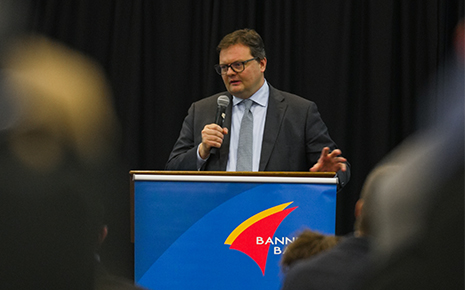
Economist Don Rissmiller, a founding partner of Strategas and featured speaker at EDASC’s Economic Forecast Night, cautioned inflation may be in the U.S. economy’s future – just not yet.
“I characterize the inflation picture as the ‘seeds of inflation’ still in the economy, but 2026 is probably a little premature to make that bet,” Rissmiller said.
Based on models he has run, periods of high inflation historically are followed by an “echo” a few years later. This holds true not just for the United State but globally – 87% of the time.
But the conditions aren’t quite right for inflation to rebound in the moment, Rissmiller said.
Shocks and cushions tell story of the economy
While the U.S. economy has sustained many shocks over the last year that could easily herald inflation, these shocks have been offset by activities that serve as cushions.
For example, he said, the DOGE cuts to government jobs and the prolonged government shutdown in 2025 were a shock to the labor market, but loss of those jobs was cushioned by the healthcare sector consistently adding jobs thanks to an aging population.
The healthcare sector alone can’t prop up the labor market, especially as “dramatic U.S. immigration restrictions” have constricted labor force participation. Here, the “cushion” is an improvement in productivity, as measured by output per hour.
AI is aiding in this productivity bump, but gains in the economy will depend largely on both the AI producers and AI users benefiting from the technology.
“We need the profits of the users to go up,” Rissmiller said.
The shock from tariffs – which Rissmiller characterized as an “inefficient sales tax applied at a national level” – continues to linger. However, consumer spending has actually continued to trend up.
Rissmiller says this is in part because upper-income households are bolstered by the “wealth effect,” as their assets in stocks, bonds and real estate continue to perform well. Interestingly, spending in lower-income households continues as well. Rissmiller sees this as a nod to the gig economy, where flexible gig work can help with extra cash to stretch spending.
Fed independence under a microscope
In the past year President Trump has put pressure on Federal Reserve Chairman Jerome Powell to lower interest rates, while the Powell and the Fed have remained cautious in deciding when and by how much to lower rates as they balance interest rates against unemployment rates.
“From the very beginning, the Fed as an institution has had to balance conflicting interests,” Rissmiller said, noting this isn’t the only time in history when the president has leaned on the Fed’s leader.
Yet the Fed’s independence has come into question most recently as the president has continued to put pressure on Powell.
Rissmiller made the argument that the recent split vote on interest rates is actually a sign of independent thinking, more so than a unanimous vote would be. But he does caution if the Fed were to lose its independence, it would be far worse for the economy than the inflation caused by the current tariffs – by a factor of 11.
Does war in the Middle East change everything?
Rissmiller spoke just days before war in the Middle East erupted, introducing another economic shock. EDASC asked him 11 days after the start of the war how he thinks it will affect the economy.
“The U.S. economy has been hit by numerous shocks in the past year, including tariffs, a substantial change in immigration policy, which affected labor supply, and now an energy price shock due to geopolitical events,” Rissmiller said via email.
“The U.S. consumer has found ways to manage, and a decline in the personal saving rate could provide a short-term cushion. The current tax refund season is also expected to be strong, which is another offset. But these cushions won’t last long, highlighting the need for a quick resolution to the conflict in the Middle East.”
More Topics

Getting to know the SWIFT Center
Mar 2 2026