

Pacific Rim Tonewoods: Rural for a reason
2 Mar 2026
News
Heading east on Highway 20, grey-green foothills provide the backdrop to Big Leaf Maples presenting their rust-and-gold autumn finery, brilliant against the early November scene.
The maples serve as a fitting welcome to Pacific Rim Tonewoods, maker of fine wooden components for stringed instruments – mostly guitars – that include the Fiddlehead Maple among the wood varieties they work with.
Steve McMinn, founder of Pacific Rim Tonewoods, discovered the 20-acre property in Birdsview in eastern Skagit County more than 30 years ago with the help of then-executive director of EDASC, Don Wick.
In the ensuing years, PRT has grown from four employees to 28 (numbering as many as 35 employees), partnered with notable guitar makers including Taylor and Martin, started sustainable forestry projects, and, most recently, began carving out a niche in wooden bowls.
It’s a business that couldn’t easily exist in an urban setting, and McMinn values his rural location for its inherent advantages.
Defining rural
Even with its bustling hub cities, Skagit County is considered rural. Washington state officially designates 29 of Washington’s 39 counties as rural, including Skagit. Rural counties are defined by state code having a population density of less than 100 people per square mile, or a county smaller than 225 square miles.
This definition was outlined as part of legislation that established a funding mechanism for rural counties to use 0.09% of sales tax collected for economic development and affordable housing.
The state’s economic development efforts are championed by the Department of Commerce, which oversees the network of Associate Development Organizations (ADOs) throughout the state that carry out economic development work at the county level. Each county has an entity responsible for serving as its ADO. EDASC is the ADO for Skagit County.
Economic development is defined by the state as “purposes which facilitate the creation or retention of businesses and jobs,” but exactly how each ADO goes about that in their communities looks different based on local resources and needs.
“Nowadays, most economic developers recognize the importance of addressing systemic challenges that particularly rural communities face,” EDASC CEO John Sternlicht said.
“That is why, over the last several years, EDASC has focused to an increasing extent on housing, workforce, and childcare as economic development issues on top of business expansion and attraction.”
Sternlicht points to a recent International Economic Development Council (IEDC) survey of rural communities, where respondents highlighted concerns over the housing shortage, declining downtowns, young people leaving, and lack of childcare.
Similar to what EDASC has found in its surveys, respondents to the IEDC survey stated rural small-business concerns focus primarily on the lack of appropriately skilled workers and suitable buildings, as well as the lack of public and private support.
In Skagit County, “we are constrained as to available land for development,” Sternlicht said. “Once you eliminate flood plains and agricultural land from consideration, available commercial/industrial properties with improvements are even more rare.”
Availability of adequate electric power and, in some parts of the county, availability of water could present challenges for a business wishing to expand or relocate here.
With a tight labor market and the need for local talent trained for the jobs of the future, employers are concerned about workforce development as well.
“But all this should not be taken as discouraging – merely as refinements to any economic development strategy,” Sternlicht said. “Both home-grown and new businesses could thrive here even within those limitations, if we customize our efforts.”
Looking past the challenges, Skagit County counts its natural beauty and small-town support of local enterprises among the advantages of living and doing business here.
EDASC works to accentuate those advantages while fostering growth opportunities to meet its challenges.
More than place – people
Rural businesses are as varied as the people who live in these communities. Logging and agriculture may immediately come to mind, but it’s just as likely to be the local auto repair shop or a river tour guide. A throughline for rural small businesses is an ethos of resourceful owners who are connected to the land via occupation or lifestyle.
Practically, McMinn says his business producing soundboards and sides for guitars couldn’t easily exist in an urban setting – land costs would be much higher, and the business wouldn’t be as close to its source material in miles or in inspiration.
A benefit of rural communities is that payroll costs are typically lower than in urban areas, although McMinn notes having the refineries and big aerospace employers in Skagit County skews the overall pay rate for manufacturing jobs here.
Manufacturing is a strong presence in Skagit County. According to state Employment Security Department numbers, manufacturing is the top employer by industry here, with 803 firms paying $1.8 billion in wages in the first quarter of 2025.
PRT employees come from Rockport, Concrete, Lyman, Sedro- Woolley, and as far afield as Bellingham and Marysville. They range in experience from new college grads to employees with decades with the company.
“I love that we have got all these multiple generations. People are so very skilled,” McMinn said.
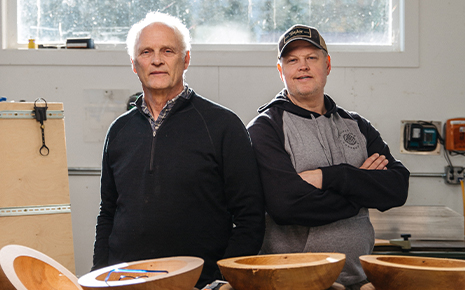
Eric Warner is one of the team members who’s been with PRT for years, three decades to be exact.
McMinn said Warner started with the company when he was 18 and today is McMinn’s business partner.
While PRT employees often use machining technology, robotics and sonic measurement tools, McMinn classifies his employees as “handy” folks who lean on their rural roots and practical problem-solving skills.
He sees this as a strength that some urban dwellers might not exhibit.
Unfortunately, tariffs established in 2025 put pressure on both production and sales, causing PRT to lay off employees.
McMinn said tariffs affect equipment purchased overseas, such as a specialized sawmill from Italy that was installed in February 2025, as well as tariffs on spruce sourced from Canada. Canadian spruce had a 10% tariff as of November 2025.
And consumers are more cautious as well, causing sales to soften.
“Consumer confidence just plays into everything,” he said.
Due to these economic pressures, McMinn estimated 2025 revenue would be about 80% of 2024’s total.
Betting on bowls
Being located in a rural county, PRT has been able to take advantage of grant programs targeted to rural communities.
For instance, a $400,000 U.S. Forest Service grant enabled the company to install a solar array atop one of its buildings. The array went online late last year, and now it produces one-half to two-thirds of the energy PRT uses. This is welcome relief as energy costs continue to rise, McMinn said.
A second Forest Service grant for $300,000 is helping them to develop a new line of business, manufacturing “bowl cores” from wood that would otherwise be a waste product in the operation.
As a business owner, McMinn says, “[I’m] always looking – Where are there more opportunities? What else can we do?”
McMinn said the matching grant funds helped to pay in part for engineering salaries, research and development, and general startup costs.
The bowl cores come from wood unusable for soundboards due to size, knots or other imperfections but are perfectly suited for artisan woodworkers. The bowls make use of wood that before would have been scrap or even left to rot on the forest floor, McMinn said.
Sustainability is woven into the work at PRT, where forestry meets manufacturing, so it seems like a natural move to diversify by creating a new revenue steam from the wood that doesn’t make it into a guitar soundboard.
After the bowl cores are cut using a robot, they are dried for a week in the same kiln used for curing soundboards. The cores are then ready to become finished bowls in the hands of wood turners or carvers.
PRT plans to go to market with the bowls in spring, both selling to retailers and directly online.
Fine musical instrument components and home goods are an unlikely pairing, but resourceful rural people have made the practice of using everything they can long before sustainability was a buzzword. With this mindset, McMinn and the entire team at Pacific Rim Tonewoods have built a culture of ingenuity and adaptability.
More Topics
Getting to know the SWIFT Center
Mar 2 2026